The Day My Heart Stopped: Why Every School Needs to be Heart Safe
On August 24, 2006, I was coaching at my dad’s basketball camp in Connecticut. I had just come inside with the kids and was sitting on the bleachers when, without warning, I went into sudden cardiac arrest and fell from the bleachers onto the floor.
There was no AED in the building, and no one around me knew what to do. That's the part I want people to understand. Someone called 911, and that's when a volunteer EMT who was working next door got the call on his pager and rushed over, finding me on the ground. He started CPR right away and kept me alive until the ambulance arrived. I was shocked by the defibrillator brought by EMS and then rushed to a local ER and eventually to Connecticut Children's Medical Center, where I woke up three days later. Because there was no AED nearby when I went down, doctors later told me my chances of survival had been one in a million.
That's when doctors also found the underlying cause: Hypertrophic Cardiomyopathy (HCM), a thickening of the heart muscle that had put me at risk all along without anyone knowing. I received an implantable cardioverter-defibrillator (ICD) and was told, at 17 years old, that I would never play competitive basketball again.
Losing the game that I loved was hard. But I was alive, and I understood exactly why: a volunteer who knew CPR, and an automated external defibrillator (AED) that reached me just in time. That understanding became the foundation of everything I've done since. My mother and I became American Heart Association (AHA) volunteers, lobbying in Hartford and Washington, D.C. for laws requiring AEDs in Connecticut schools, so that no one else would have to wait for an ambulance to have access to a defibrillator. It was the first time I saw how much could change when the right equipment and the right training were in the right place at the right time. I went on to Quinnipiac University and built a path in coaching instead of playing, a different journey, but still a way to stay close to the game.
Then, in 2014, my heart reminded me it wasn't finished testing me. A routine surgery to replace my ICD's battery led to complications, and months later the device became infected. Removing it triggered emergency open-heart surgery. I spent Thanksgiving that year in intensive care, receiving eight blood transfusions. In January 2015, I received a new subcutaneous ICD, and I walked away from that experience with a mission I couldn't ignore: nobody else should have to depend on luck the way I had, twice.
That mission became In A Heartbeat. What started with my family and friends has grown into an organization dedicated to preventing sudden cardiac death (SCD) through early detection, emergency preparedness, and community education. Every day, 1,000 people in the United States suffer a sudden cardiac arrest (SCA), and most of them don't have a trained responder and an AED nearby the way I did. We're working to change those odds.
Today, our Cardiac Screening Program has provided more than 12,000 free electrocardiograms (ECGs/EKGs) to children, teens, and young adults across Connecticut and the Northeast. One in 300 kids has an undetected heart condition, and a stethoscope alone misses it 96% of the time. Our AED Donation Program has placed nearly 1,000 AEDs in schools, athletic facilities, and public spaces. Through our CPR/AED training, we have reached almost 9,000 people. Together, these efforts have helped save at least 83 lives. That’s 83 families who didn't have to face the odds I once did.
None of this work happens in isolation, and that's why I'm so proud that In A Heartbeat partners with Project ADAM at Yale New Haven Children’s Hospital, Project ADAM CT at Connecticut Children’s (coming soon!) and Project ADAM NY on their Heart Safe Schools program. Together, we believe we're able to offer schools something rare: a complete program of both primary and secondary prevention of sudden cardiac death.
Our Cardiac Screening Program is primary prevention. Our free EKGs, read by pediatric cardiologists who volunteer their time, are designed to identify conditions like the Hypertrophic Cardiomyopathy that caused my arrest. By identifying young people at risk, they can receive timely medical that can help to prevent SCA. Project ADAM's Heart Safe Schools program is secondary prevention. It ensures that when a cardiac arrest happens, despite every screening and every precaution, a school has an AED close by, staff and students trained to use it, a cardiac emergency action plan (CERP), with drills practiced, well before it's needed.
My own story is really the case for combining both. Nobody caught my heart condition beforehand, and there was no AED in the building when I went down, so secondary prevention (a trained volunteer and an ambulance defibrillator that reached me in time) is the only reason I'm here to tell my story. Through our partnership, we bring schools the templates, checklists, and one-on-one consultations they need to become designated Heart Safe, and we connect that designation directly to our own AED Donation Program and Cardiac Screening Program, so a school isn't just checking a box, it's building both halves of real protection at once. That's the kind of layered, complete prevention I wish had existed in that gym back in 2006.
I've now survived two events that very easily could have ended differently. I don't take that for granted, and I don't take this partnership for granted either. Every Heart Safe school we help certify, every AED we place, every EKG we provide, is one more chance for someone else's story to end the way mine did, with a second chance, instead of the alternative.
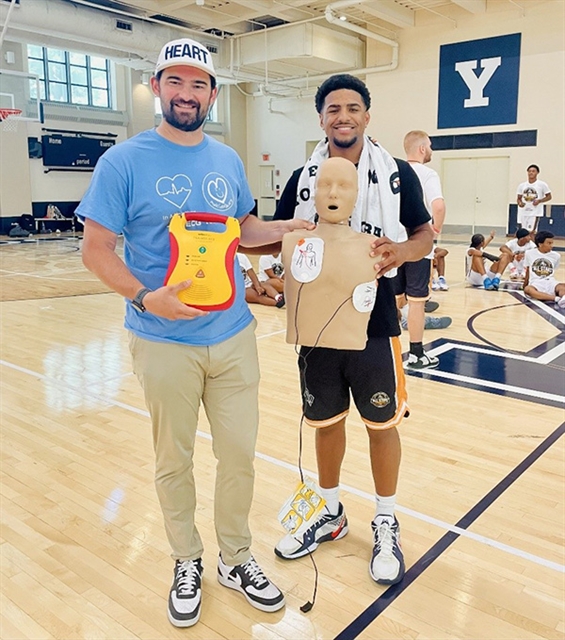
Mike Papale and fellow SCA survivor volunteering at a youth basketball camp.
If your school or organization wants to learn more about becoming Heart Safe, or about how our AED Donation Program and Cardiac Screening Program can support that certification, I'd encourage you to reach out to your local Project ADAM affiliate, or to In A Heartbeat directly. Preparedness isn't something you build after an emergency. It's something you build long before one, in the quiet, ordinary days when nothing seems to be at stake at all. That was true for the volunteer who responded to help me in 2006, and it's true for every school, coach and volunteer who commits to becoming Heart Safe today.
It genuinely can happen in a heartbeat. My story is proof of that. But with the right partners, the right equipment, and the right preparation in place, a SCA can end well and someone will live to tell their own story.